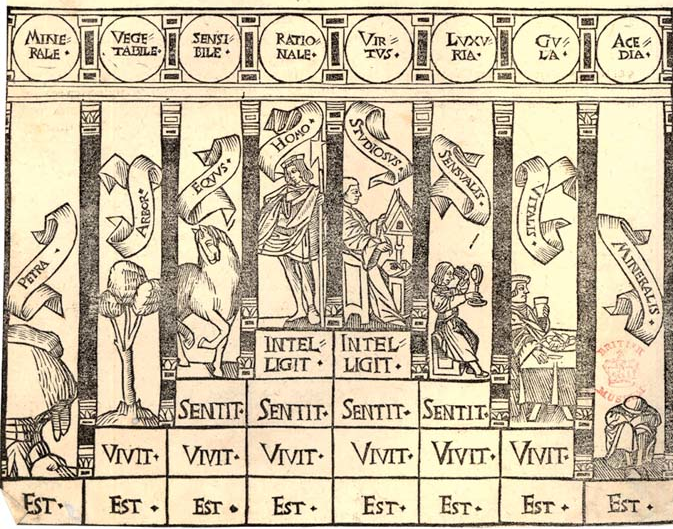
The Pyramid of Living Beings (1509) by Charles de Bovelles shows living and non-living species arranged in ascending order. Man is depicted as possessing the faculty of understanding (intelligit).
Published on February 18, 2026
A few days ago I was watching a time-lapse video that showed how plants move throughout the day, and it amazed me that our timescale is so different from theirs. I look at the plants I have at home and realize that I never see them differently. They are always in the same position, still in their clay pots, patient, each one next to the other on the balcony, waiting for their vital energy source to arrive: the sun.
So I immersed myself in trying to understand why, and I discovered that plants have certain sensors and receptors that allow them to perceive external stimuli. With them they detect light, thermal, and gravitational signals from their environment, generating a response to each of these events (whether of natural or artificial origin). Thanks to this ability to register signals from their surroundings, process the information obtained, and calculate the most appropriate solutions for themselves, researchers have concluded that plants possess a level of intelligence far more complex than we usually believe. There is one species in particular, the Walking Palm, which can reach more than twenty meters in height, and what is fascinating is that its trunk appears suspended in the air. Its roots are what support it and allow it to “walk.” It does this when it feels threatened by competing species: it produces new roots in the direction it wants to move while abandoning others. When I read this, the image of Tolkien’s Ents immediately came to mind, walking very slowly, at their own pace, but with firm and confident steps toward where they were going.
The Pyramid of Living Beings (1509) by Charles de Bovelles shows living and non-living species arranged in ascending order. Man is depicted as possessing the faculty of understanding (intelligit).
I feel that we live in excessively accelerated times, far removed from the rhythms of plants. We move in encapsulated directions, detached from (our) reality, pulled by uncertainty and the lack of certainties that, in their different layers, are surrounding our world. Everything seems insufficient; there is always something more on our to-do lists, always something more to self-improve (or self-exploit), and our era overflows with possibilities because everything supposedly depends on ourselves — perhaps it could be read as a false freedom. I believe that the speed at which our society operates is what is leading us toward physical, mental, and emotional saturation. It is the famous “burnout,” where our attention has to branch out among different tasks, sources of information, and processes, performing with an almost inhuman — nearly machine-robotic — effort, like those dystopian and futuristic films: Blade Runner or Ex Machina are the first that come to mind.
Recently I realized that we have just passed the first quarter of this millennium… and everything that has happened in this time has been so radical: everything that was built, destroyed, reformulated; what came and what went. Cities changed, technology became increasingly present in our lives, and without realizing it, today our relationships largely develop through virtuality. Lately I think a lot about this — about how the construction of our bonds with other people has become a system of rules, and our communications have almost transformed into a binary system. We have to know when to write, when to respond (and what to respond), how much time to let pass before doing so, when to give likes and when to comment. Strategically we generate and shape our affective relationships, but the problem is that we increasingly do so from mirrored, narcissistic-individualistic, and performative perspectives. I feel that, little by little, we are losing an essential part of ourselves: relating in person, going outward, stepping outside for a while into nature — not nature as such, but as a communal space, depersonalized in the sense that it exists outside our virtual home-space — and chatting in a relaxed way, without that system of rules that turns us into chess players…

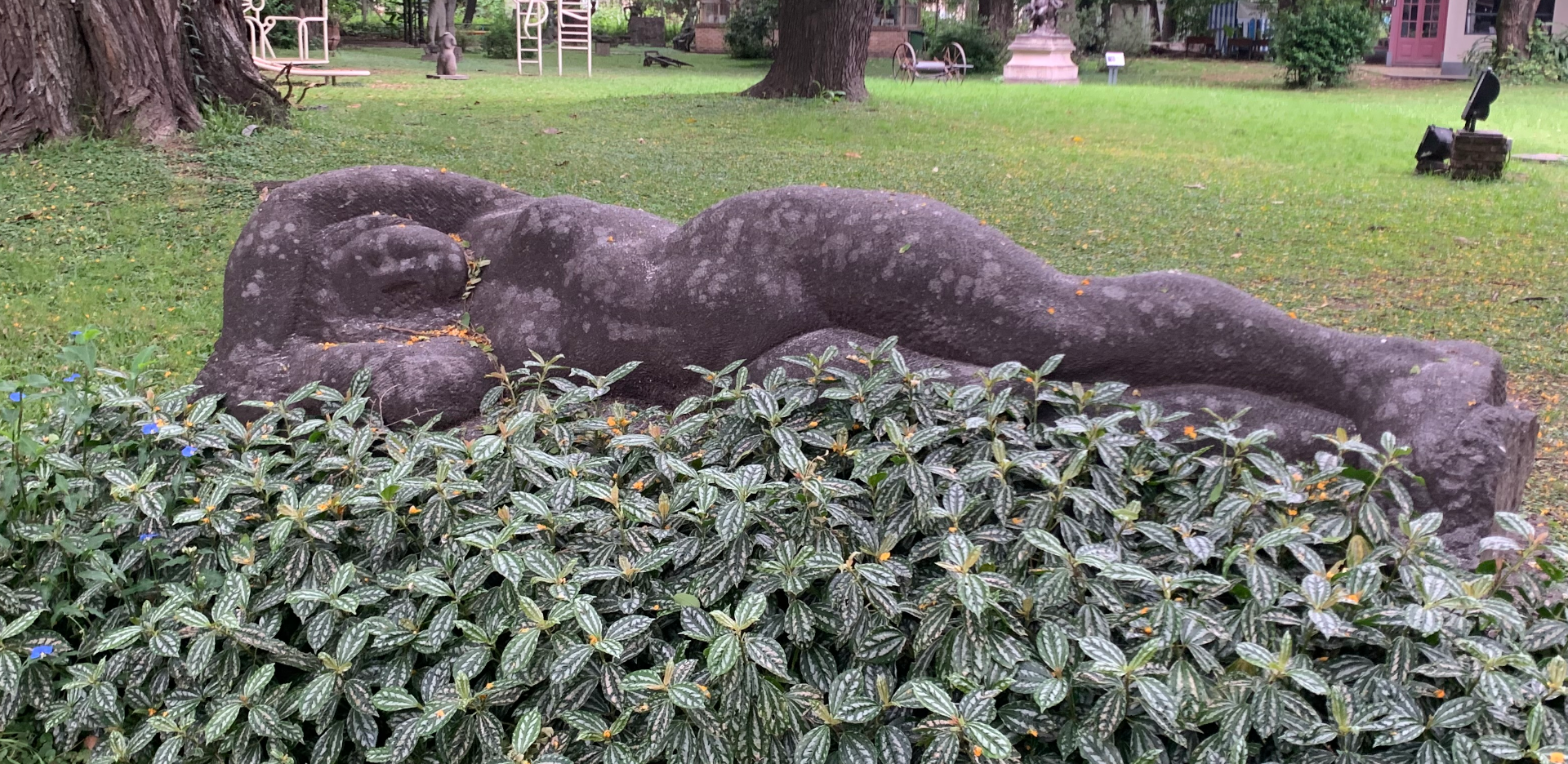
[ŚŪ] (2025) por Ni Petrov.
In the last fifty years, research and discoveries about plants have invited us to observe them with much more attention (and affection). Thanks to the receptors and sensors mentioned earlier, which not only help them orient themselves in their environment but also interact with other plant and animal organisms, we now know that plants can recognize individuals of their own species. A very concrete (and, to me, quite poetic) way to perceive this is simply to lift our gaze toward the tops of trees and observe certain patterns of “gaps,” like airy puzzles between their crowns. Although the cause of this phenomenon is not known with certainty, there is a theory that resonates with these reflections: trees can detect light levels and the presence of foliage from others of their same species; therefore, they regulate their growth to remain outside each other’s space. Something like a collective and respectful spatial regulation. This reinforces the evidence of what is known as swarm intelligence — that they do not behave solely as isolated individuals, but as a multiplicity that manifests group dynamics and behaviors.
I think about how fascinating plants are among themselves, living together in community, in vegetal networks, and I inevitably compare this with our collective feeling of loneliness, with the social fragmentation that runs through our days and from which our conflicted moods emerge.
Despite these moods, I felt in tune with the idea that Donna Haraway proposes with the concept of the Chthulucene, an idea in which response-ability toward and with living beings becomes necessary in order to inhabit our world, which is currently in disturbing and confusing times — the era of the Anthropocene. Within this framework appears the notion of tentacular multispecies thinking: threading, entangling, and working around diverse ways of thinking; a way of seeing and caring for our world and other worlds, reconnecting with everything that was left aside or placed below the human species — more precisely, below the figure of Man.
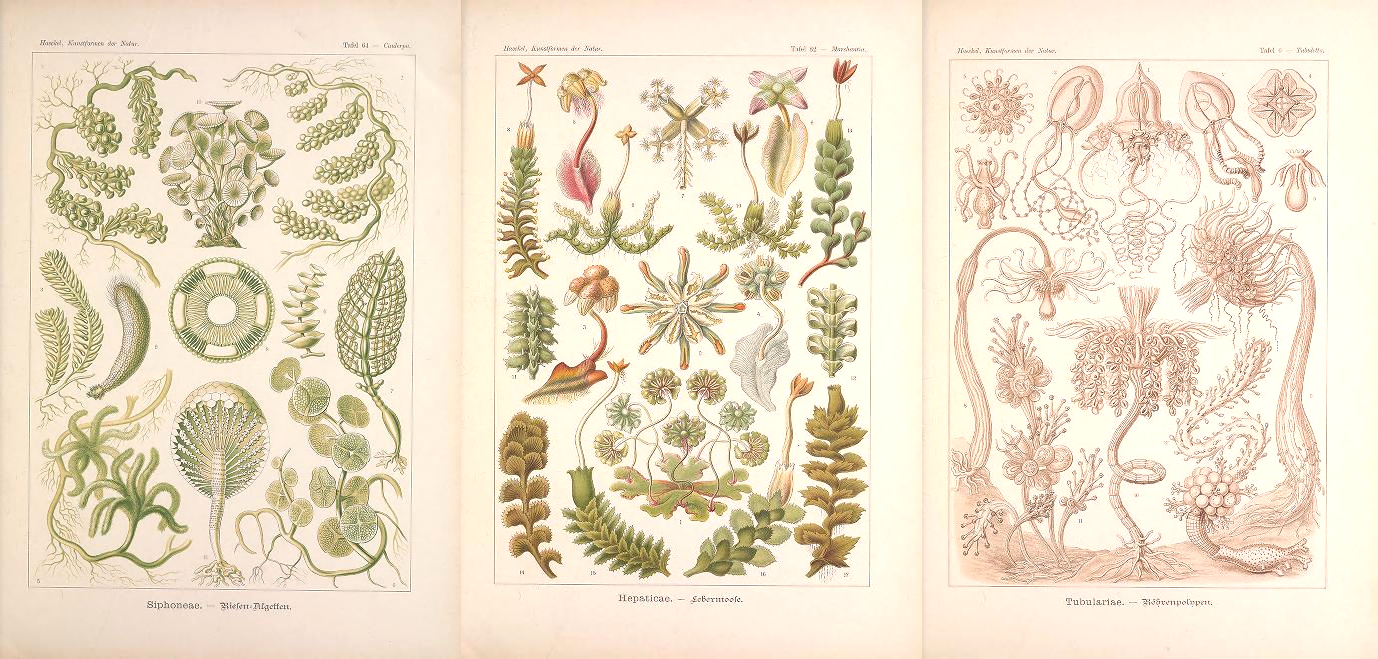
Illustrations taken from Kunstformen der Natur (1899) by Ernst Haeckel, courtesy of the Bibliographisches Institut, Leipzig.
In this context, response-ability functions as an antithesis to the disconnected and solitary action of Man the creator; it implies being truly present and conscious of all times (past, present, and future), of all places, of all creatures… and, I would add, of all plants. Following this tentacular thinking, Haraway brings in the notion proposed by Lynn Margulis of symbiogenesis: the idea that living beings do not evolve alone, but rather, by living and collaborating for long periods across different species, new biological units (new tissues, organs, organisms) and even new species are formed.
The relationship between these ideas invites us to think that we need nonhuman species in order to live — many other forms of life. Our existence flourishes from interdependence with plant, animal, and microbial species; with the chemical elements of the Earth, minerals, water, the sun, the stars, and the planetary and cosmic processes that are present here and now.
What can we do with our desire to build something solid in a liquid and distant world? Perhaps we could try moving in slower times, rooted… almost vegetal. I believe that plants, with their subtle and perceptive movements, offer us an alternative to our ways of inhabiting — deeply intertwined with presence, interdependence, and sensitivity.
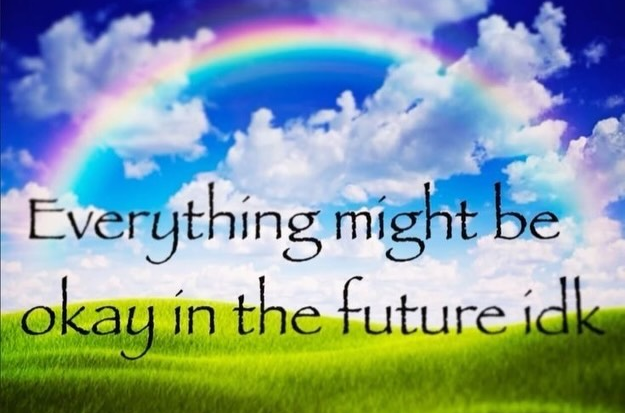
"Everything might be ok in the future, I don't know" by unknown authorship.
References
Sotelo, A. A. (2015). El Movimiento de las Plantas-: Tropismos y Nastias. PhD diss., Central European University.
Cassab, G. I., & Sánchez, Y. (2006). Diferenciación y crecimiento diferencial: la capacidad motriz de las plantas. Fisiología vegetal, 1-26.
Haraway, D. J. (2019). Staying with the trouble: Making kin in the Chthulucene. Duke University Press.
Mancuso, S., Viola, A., & López, D. P. (2015). Brilliant green: The surprising history and science of plant intelligence. Barcelona: Galaxia Gutenberg.
Han, B.-C. (2012). The burnout society. (A. Saratxaga Arregi, Trad.). Ed. Herder.
Ni Petrov [ŚŪ] (2025)